
Liquid Bulk Will Require More Than R$130 Billion in Infrastructure by 2037, Leggio Study Finds
A study by Leggio Consultoria, a firm specializing in logistics infrastructure, finds that Brazil's liquid bulk market will require more than R$130 billion in infrastructure investment through 2037. The findings were presented at the 2026 edition of the ROG-e trade show and reported by journalist Carmen Nery of Portos e Navios.
More Than R$130 Billion in Upgrades and New Projects
According to the study, the investments include upgrades and greenfield projects tied to waterway and overland access, pipeline networks and terminals, from the north to the south of the country. The estimated breakdown is as follows:
Railways: up to R$6.5 billion
Waterways: R$985 million
Port terminals: R$2.2 billion
Pipeline network: R$430 million
Multisector portfolio: R$121 billion
Estimated Logistics Gains of R$1.36 Billion per Year
Leggio has been assessing the liquids market and its investment needs since 2018. The study estimated logistics gains of R$1.36 billion per year, with investments on the order of R$9.1 billion to R$124 billion in infrastructure for fuel handling, removal of operational bottlenecks, optimal supply assurance and lower logistics costs.
Fuels Are the Largest Cargo in Coastal Shipping, and the Supply Chain Has Its Own Dynamics
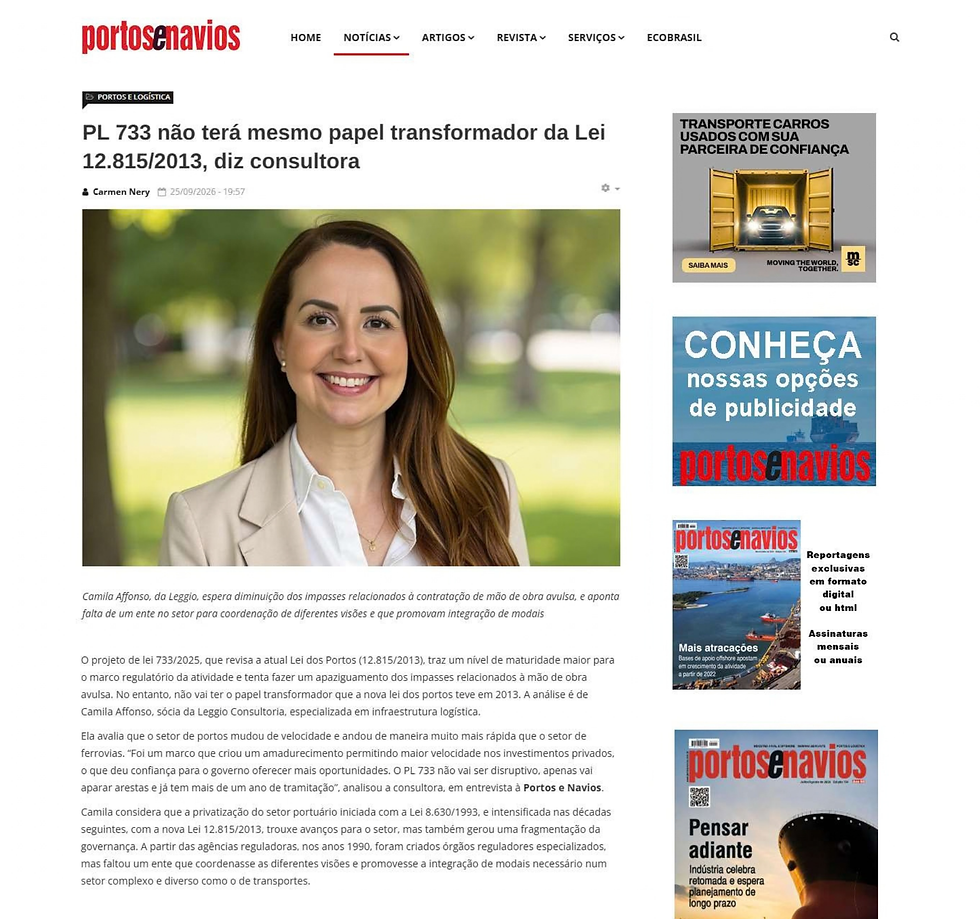
According to Camila Affonso, a partner at Leggio Consultoria, the fuels sector has specific characteristics within the country's energy security landscape. "Fuels are still the largest cargo in coastal shipping, and the segment is highly concentrated in Petrobras's refining capacity. The distribution infrastructure runs from the supply points to the primary terminals and bases, always moving large volumes by road, pipeline and rail, and then distributing by coastal shipping. This is a sector with its own dynamics, operating within the country's energy security environment, with very heavy exposure to commodity price swings around the world," she said.
On the regulatory side, the segment has a more complex division of responsibilities: it is subject to the oversight of infrastructure regulators such as the National Waterway Transportation Agency (Antaq) and the National Land Transportation Agency (ANTT), with the National Agency for Petroleum, Natural Gas and Biofuels (ANP) closely monitoring its activities.
Fuel Imports and Biofuel Blending Are Straining Infrastructure
Camila also noted that Brazil's need to import fuels isn't going away as domestic production and biofuel blending increase, with the blending curve rising both for biodiesel added to diesel and for ethanol added to gasoline. "This growing need puts pressure on infrastructure, and there is demand for transportation in regions that weren't prepared for it. It's worth citing both the start-up of new production capacity, such as the Abreu e Lima Refinery (RNEST), and others that are back under discussion. There are new investments in ports such as Paranaguá (PR), which could rebalance the use of infrastructure," the consultant said.
Read the full article on Portos e Navios: https://www.portosenavios.com.br/noticias/portos-e-logistica/graneis-liquidos-demandarao-mais-de-r-130-bilhoes-para-infraestrutura-ate-2037


Comments