
Bill 733 should smooth out some of the port sector's rough edges, but won't have the transformative impact of the 2013 ports law
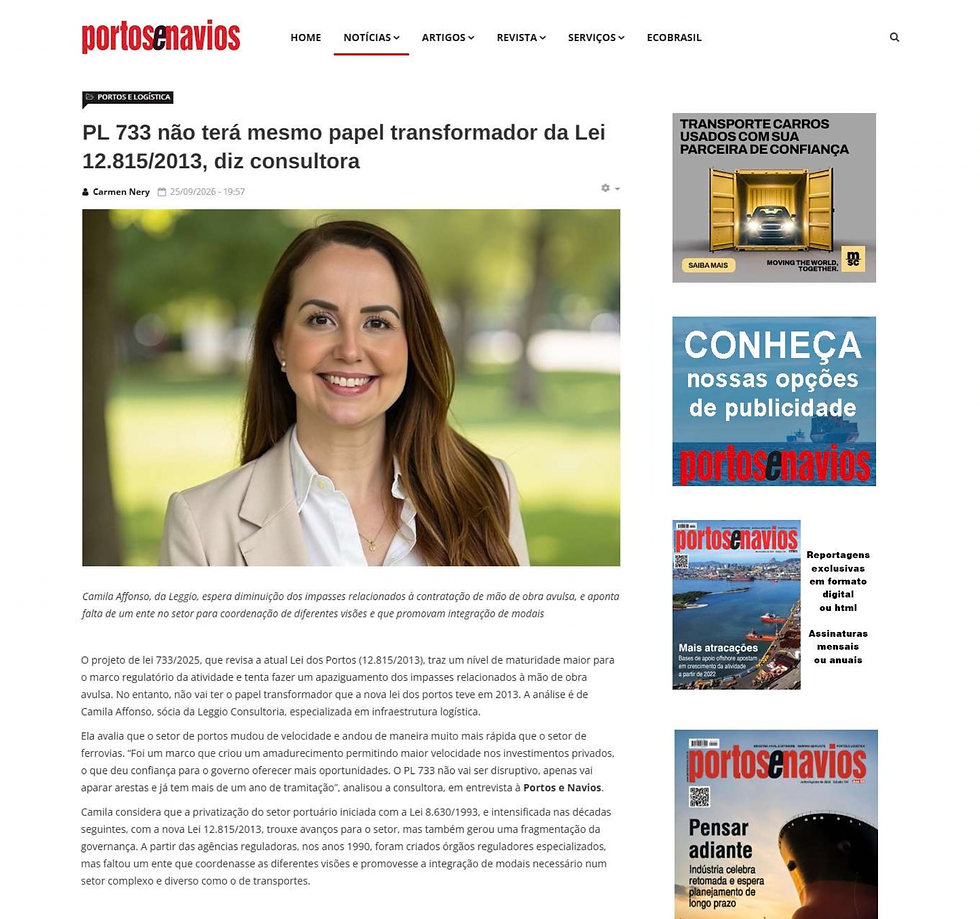
In an interview with Portos e Navios, Camila Affonso, a partner at Leggio Consultoria and an infrastructure logistics specialist, assessed Bill 733/2025, which revises Brazil's current Ports Law (12.815/2013). In the consultant's view, the proposal brings greater maturity to the regulatory framework and aims to ease disputes related to the hiring of casual dockworkers, but it isn't expected to have the transformative impact the 2013 law had.
The Port Sector Gained Momentum Faster Than the Rail Sector
According to Camila, the port sector matured and gained momentum in private investment more quickly than the rail sector. "It was a milestone that created a level of maturity allowing faster private investment, which gave the government the confidence to offer more opportunities. Bill 733 won't be disruptive, it's just going to smooth out rough edges, and it's already been in the works for more than a year," she said.
Fragmented Governance Remains a Gap in the Sector
According to Camila, the privatization of the port sector, which began with Law 8.630/1993 and intensified under Law 12.815/2013, brought progress to the sector but also led to fragmented governance. With the creation of regulatory agencies from the 1990s onward, the sector gained specialized bodies, but, in the consultant's view, it still lacks an entity to coordinate the different perspectives and drive integration across transport modes.
Regulatory Instability Affects the Value of Port Assets
The consultant warns that regulatory instability can undermine the value of large-scale assets, citing the case of Tecon Santos 10. According to her, contradictory decisions on bidding terms affect pricing and drive up financing costs — which is why, in her assessment, the rules governing the sector should be established through national regulation.
Private Terminals (TUPs) Coexist Unevenly With Public Ports
Law 12.815/2013 enabled the expansion of Private-Use Terminals (TUPs), which today coexist with public ports in different ways depending on the region. In Santos, Camila describes a relatively peaceful coexistence despite fierce competition between BTP and Santos Brasil; in Paranaguá, there's no prospect of a second container terminal; while in Pernambuco, the APM Terminals Suape TUP, part of the Maersk Group, and Tecon Suape, operated under a lease by the ICTSI Group, have a much more tense relationship.
"In Santos, there was a significant demand for additional capacity that was resolved with the arrival of Embraport (now DPW). But it shouldn't be forgotten that Libra, which was the country's second-largest terminal, was closed for months. On the other hand, the solution for Paranaguá came through Santa Catarina, where Portonave and Itapoá were developing additional capacity, both with room to expand. In Santos's case, there was greater pressure to deepen the access channel once the TUPs arrived. In Suape, on the other hand, the friction exists because the coexistence there is just getting started," she said.
Each Terminal's Economic Structure Shapes Competition for Cargo
In Camila's assessment, how this coexistence plays out depends on how balanced each operator's economic structure is: whoever paid a concession fee for an already-built asset is bound to using casual labor under Ogmo's rules, while whoever makes a new investment has more control over its own productivity. "If both sides' economic structures are balanced, this coexistence can work [...]. For society, it could mean lower costs. In Santos, there are some very important players, but Santos Brasil is a capacity powerhouse capable of withstanding this kind of competition," she concluded.
Read the full article on Portos e Navios: https://www.portosenavios.com.br/noticias/portos-e-logistica/pl-733-nao-tera-mesmo-papel-transformador-da-lei-12-815-2013-diz-consultora


Comments